


Why SEO Is the Most Underrated Sales Channel for Indian Manufacturers in 2026
SEO is the most underrated sales channel for Indian manufacturers because most B2B buyers now research, compare and shortlist suppliers online before they contact anyone. If your products don’t appear on Google or in AI answers during that research stage, you usually never make the shortlist, however good your plant, pricing or quality may be.
Most manufacturers we speak to in Gujarat still rely on three channels: referrals, trade fairs and B2B marketplaces. All three still work. But none of them reaches the buyer at the moment they open a browser and type “[your product] manufacturer in India.” That moment is where many supplier decisions are now quietly made.
Quick summary
- B2B buyers spend far more time researching on their own than talking to suppliers.
- Most buyers already have a preferred vendor before their first call and that vendor usually wins.
- SEO puts your products in front of buyers during that research stage, in India and abroad.
- The same work also makes your company easier for AI tools like ChatGPT and Google AI Overviews to recommend.
How B2B Buying Changed: Suppliers Are Shortlisted Before the First Call
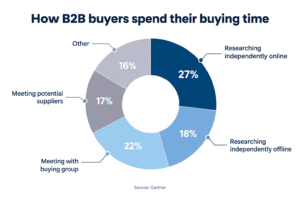
B2B buyers now make most of their decision before speaking to a supplier. Gartner’s research on complex B2B purchases found that buyers spend only about 17% of their total buying time meeting potential suppliers and that time is shared across every supplier they are considering. Around 27% goes into researching independently online.
More recent data points the same way. In 6sense’s 2025 study of nearly 4,000 B2B buyers, the average first contact with a seller happened when buyers were about 61% of the way through their buying process. The vendor buyers preferred before that first contact still won about 80% of deals.
For an Indian manufacturer, the meaning is simple. By the time a procurement manager calls you, they have usually already:
- Searched for suppliers by product, grade, application or location
- Visited several websites and compared specifications and certifications
- Checked reviews, directory listings and company background
- Built a shortlist often with a favourite already in mind
If your website didn’t appear in step 1, steps 2 to 4 happen without you.
Why Indian Manufacturers Still Underrate SEO
Most manufacturers underrate SEO because its results are slower and less visible than a trade fair stall or a marketplace enquiry. Four beliefs come up again in our conversations with plant owners and marketing heads.
“Our buyers don’t search online”
They do just not always for your company name. Buyers search by product, CAS number, grade, size, material or end use. A chemical buyer types “Glibenclamide Sulfonamide manufacturer in india”, not your brand. If you only rank your own name, you are invisible to new buyers.
“Trade fairs and referrals have always worked”
They still work, and you should keep them. But a trade fair reaches the buyers in that hall for three days. A well-ranked product page reaches buyers in Mumbai, Dubai, Riyadh and Houston every day, at any hour.
“SEO is slow and hard to measure”
SEO is slower to start than paid ads usually 3–6 months before steady enquiries for a B2B manufacturer. But it is measurable: rankings, organic visits, form fills, WhatsApp clicks and calls can all be tracked to the page that produced them. And unlike ads, a ranked page keeps working after you stop paying for it.
“We’re already on IndiaMART”
Marketplaces are useful, but you rent visibility there. Your listing sits beside competitors, the same enquiry is often shared with several suppliers, and the platform controls the rules. Your own ranked website builds visibility and enquiries that belong only to you.
What SEO Actually Does for a Manufacturer
For a manufacturer, SEO turns your website from a digital brochure into a source of qualified enquiries. It does this by matching your product and capability pages to the exact searches buyers make.
| Business problem | What SEO does about it |
|---|---|
| New buyers don’t know you exist | Ranks your product pages for non-branded searches like “[product] manufacturer in Gujarat” |
| Enquiries depend on a few sales people | Your website answers technical questions 24/7 and captures RFQs, WhatsApp chats and calls |
| Export growth is slow | Country and export pages put you in front of buyers in the Middle East, Africa, Europe and the USA |
| Marketplace leads are shared and price-driven | Direct organic enquiries come only to you, from buyers who already read your specs |
| Marketing spend stops working when budget stops | Ranked pages keep bringing visitors for months or years after they are built |
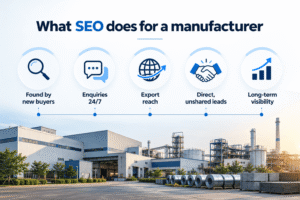
The key difference from advertising is ownership. Paid ads rent attention; SEO builds an asset a set of pages that rank, earn trust and keep producing enquiries.
SEO Now Decides Whether AI Tools Recommend You Too
AI search tools now shape supplier shortlists, and they mostly draw on the same signals SEO builds. In G2’s 2025 Buyer Behavior Report, a survey of 1,169 B2B decision-makers, nearly 8 in 10 said AI search had changed how they research, and AI chatbots were the top source influencing vendor shortlists. That survey covered software buyers, but industrial buyers are adopting the same tools.
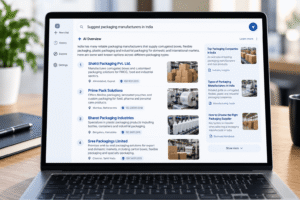
When a buyer asks ChatGPT, Gemini or Google’s AI Overview to “suggest packaging manufacturers in India” or “compare API suppliers in Gujarat”, the AI pulls from websites and sources it can read and trust. That rewards:
- Clear product pages with specifications, certifications and applications
- FAQ content that answers buyer questions directly
- Structured data (schema) that tells machines what your company makes
- Consistent company details across your website, Google Business Profile and directories
- Mentions on trusted third-party sites such as trade bodies, export councils and industry media
This is the work of AEO (Answer Engine Optimization) and GEO (Generative Engine Optimization). It sits on top of good SEO rather than replacing it. A manufacturer that invests in SEO properly today is also preparing to be recommended by AI tomorrow.
What This Looks Like in Practice
In our work with pharma, API and specialty chemical manufacturers in Gujarat, the approach stays the same. We map products to the searches buyers actually make, then track those keywords every month against a documented plan.
For an API manufacturer, that means separate targets for informational searches (“API full form in pharma”), commercial searches (“API manufacturers in Gujarat”) and product searches (“Bromo OTBN Api”). Each gets its own optimised page with CAS numbers, specifications and an enquiry path. Export directories like PHARMEXCIL and TradeIndia then support the website rather than replace it.
How a Manufacturer Should Start With SEO: 5 First Steps
Start by fixing what buyers see first: your product pages and how Google reads them.
- List your products the way buyers search for them. Include product names, synonyms, grades, CAS numbers and applications.
- Give every key product its own page. Add specifications, certifications, packaging, MOQ and a clear enquiry button.
- Fix the technical basics. Mobile speed, indexing errors in Google Search Console, and a clean sitemap.
- Set up Google Business Profile and directory listings with identical company name, address and phone number.
- Track enquiries by source. Tag form fills, WhatsApp clicks and calls in GA4 so you can see which pages bring business.
If you want to know how long each stage takes, read our guide on realistic SEO timelines for B2B manufacturers.
Frequently Asked Questions
Yes, for most manufacturers. B2B buyers research suppliers online before contacting them, so SEO reaches them at the stage when shortlists are made. Because B2B order values are high, even a few qualified enquiries a month can justify the investment.
Most B2B manufacturers see early ranking movement in 2–3 months and steadier enquiries from months 4–6. Results depend on competition, the number of product pages and how consistently content and technical fixes are done.
Yes. Export-focused pages, country targeting and presence on international directories help buyers abroad find you when they search for Indian suppliers.
It works best alongside them. Marketplaces and fairs give quick, shared visibility; SEO builds long-term visibility and enquiries that belong only to you.
It helps. AI tools favour clear, well-structured, trusted content — the same foundations SEO builds. Adding FAQ content, schema and third-party mentions (AEO and GEO) improves your chances further.
Want to know where your manufacturing website stands? SEOWebPlanet Solutions offers a free SEO and AI visibility audit for manufacturers. We check how your products rank on Google, whether AI tools mention you, and which fixes would bring enquiries fastest.
Get your free SEO audit → · or WhatsApp / call +91-7567868483