


How B2B Buyers Actually Search for Suppliers (and Why Your Brand Name Isn’t Enough)
B2B buyers search for suppliers by what they need, not by who you are. They type product names, grades, CAS numbers, applications, locations and comparisons, and increasingly ask AI tools for a shortlist. If your website only ranks for your company name, you are invisible to almost every new buyer who doesn’t already know you.
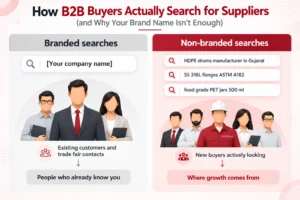
Many manufacturers check Google, see their company at the top for their own name, and assume their SEO is fine. But the people searching your brand name already know you. Growth comes from the buyers who have never heard of you, and they search very differently.
Why Ranking for Your Company Name Isn’t Enough
Branded searches bring existing customers and people who met you at a trade fair. Non-branded searches, such as “HDPE drums manufacturer in Gujarat” or “CAS 87-65-0 supplier India”, bring new buyers who are actively looking for what you make.
That distinction matters more than ever because buyers now build their shortlist before contacting anyone. In 6sense’s 2025 study of nearly 4,000 B2B buyers, the vendor buyers already preferred before first contact won about 80% of deals. If your company doesn’t appear in their non-branded searches, it rarely becomes that preferred vendor.
The 6 Ways B2B Buyers Search for Suppliers
Most B2B supplier searches fall into six patterns. Each needs a different kind of page to rank.
| # | Search type | Example searches | Page that should rank |
|---|---|---|---|
| 1 | Product + supplier type | “corrugated boxes manufacturer”, “losartan potassium API supplier” | Individual product page |
| 2 | Technical identifier | “CAS 87-65-0”, “SS 316L flanges ASTM A182”, “food grade PET jars 500 ml” | Product page with spec table and identifiers |
| 3 | Application or problem | “packaging for pharma blister”, “corrosion resistant valves for chemical plant” | Application or industry page |
| 4 | Location | “API manufacturers in Gujarat”, “packaging companies near Vadodara”, “Indian supplier of [product]” | Location page, Google Business Profile, export page |
| 5 | Comparison and evaluation | “best specialty chemical companies in India”, “HDPE vs PP containers” | Comparison guide or blog, capability page |
| 6 | Question / research | “what is API in pharma”, “how is 2,6-dichlorophenol used” | Blog post or FAQ that links to the product page |
A manufacturer that ranks only for its brand is missing all six. A manufacturer with one generic “Products” page can rank for perhaps one.
How Searches Change Across the Buying Journey
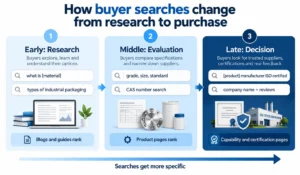
Buyers’ searches get more specific as they move closer to buying.
- Early (research): broad and question-based, such as “what is [material]” or “types of industrial packaging”. Educational blogs and guides rank here.
- Middle (evaluation): product and specification searches by grade, size, standard or CAS number. Product pages rank here.
- Late (decision): comparison, certification and supplier checks, such as “[product] manufacturer ISO certified” or company name + reviews. Capability, certification and About pages close the deal.
A strong website covers all three stages, with links from the research content to the product pages buyers need next.
How Export Buyers Search Differently
International buyers add sourcing words to their searches. They often include “India”, “Indian manufacturer”, “exporter” or “supplier from India”, plus their own technical standards and units.
- A Gulf buyer may search “Indian supplier of HDPE jerry cans” or “pharma packaging exporter India UAE”.
- A US or European buyer may search by their standard (ASTM, EN, USP or REACH) rather than the Indian description of the product.
- Many check export councils and directories (PHARMEXCIL, CHEMEXCIL, TradeIndia, ExportHub) alongside Google before shortlisting.
So export visibility needs its own pages: export landing pages, product pages that mention international standards and certifications, and consistent listings on the directories those buyers trust.
Buyers Are Now Asking AI Tools Too
A growing share of supplier research now starts in AI chat tools rather than a search box. In G2’s 2025 Buyer Behavior Report, a survey of 1,169 B2B decision-makers, nearly 8 in 10 said AI search had changed how they research, 29% said they start research with AI tools more often than Google, and AI chatbots were the top source influencing vendor shortlists. That survey covered software buyers, but industrial procurement teams use the same tools.
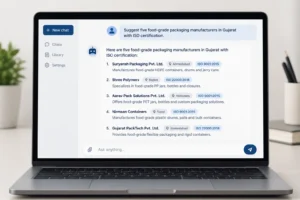
Buyers phrase AI requests as conversations, not keywords:
- “Suggest five food-grade packaging manufacturers in Gujarat with ISO certification.”
- “Which Indian companies export 2,6-dichlorophenol?”
- “Compare API manufacturers in India for losartan potassium.”
To appear in those answers, your company needs pages that state clearly what you make, for whom, with which certifications and where, plus mentions on trusted external sites. This is where AEO and GEO build on top of keyword-based SEO.
How to Build a Keyword Map for Your Products
A keyword map links each buyer search to one page on your website. You can start one in a spreadsheet in an afternoon.
- List every product and product family, with all the names buyers use: trade names, chemical names, synonyms, grades and sizes.
- Add technical identifiers: CAS numbers, HS codes, standards (ASTM, IS, USP, EN).
- Add applications and industries each product serves.
- Add modifiers: manufacturer, supplier, exporter, bulk, price, India, Gujarat, your city.
- Check demand and competition in a tool like Google Search Console, Semrush or Ahrefs, and note the questions in Google’s “People also ask”.
- Assign one main page per keyword group. If no page exists, that is a page you need to create.
Example keyword map: packaging manufacturer
| Keyword group | Example searches | Target page |
|---|---|---|
| HDPE jerry cans | HDPE jerry can manufacturer India, 20 litre HDPE jerry can supplier | /products/hdpe-jerry-cans/ |
| Pharma packaging | pharma packaging bottles manufacturer, HDPE bottles for pharma | /industries/pharma-packaging/ |
| Export | Indian packaging exporter UAE, HDPE containers exporter India | /export/ |
| Local | packaging companies in Vadodara, plastic containers manufacturer Gujarat | Homepage + Google Business Profile |
| Research questions | HDPE vs PP containers, what is UN certified packaging | Blog posts linking to product pages |
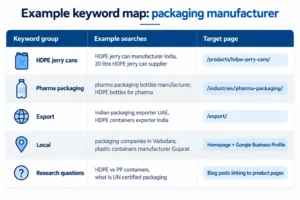
In our own work with pharma and chemical clients, this map becomes the backbone of the monthly SEO report: we track the priority keyword for each page every month, so movement and gaps are visible at a glance.
Frequently Asked Questions
Mostly through non-branded searches on Google (by product, specification, application and location), plus B2B directories, LinkedIn and, increasingly, AI tools like ChatGPT and Gemini. They usually build a shortlist before contacting any supplier.
Usually because there isn’t a dedicated, well-structured page for each product, or the pages lack the technical terms buyers search for. Technical issues such as indexing errors or slow mobile pages can also hold rankings back.
Searches that don’t include your company name, such as “[product] manufacturer in India”. They bring new buyers who don’t know you yet, which is why they matter most for growth.
Adoption is growing fast. Surveys of B2B buyers show AI chat tools now influence many vendor shortlists, and procurement teams increasingly use them for first-round research.
There is no fixed number. Start with one keyword group per important product or product family, plus a few for applications, locations and export markets, and expand from there.
Want to see which buyer searches your company is missing? SEOWebPlanet Solutions will build a free starter keyword map for your top products and show where you rank today, on Google and in AI answers.
Get your free keyword & AI visibility check → · or WhatsApp / call +91-7567868483