


Your Website Is Your 24/7 Sales Engineer: How SEO Turns Product Pages into Enquiries
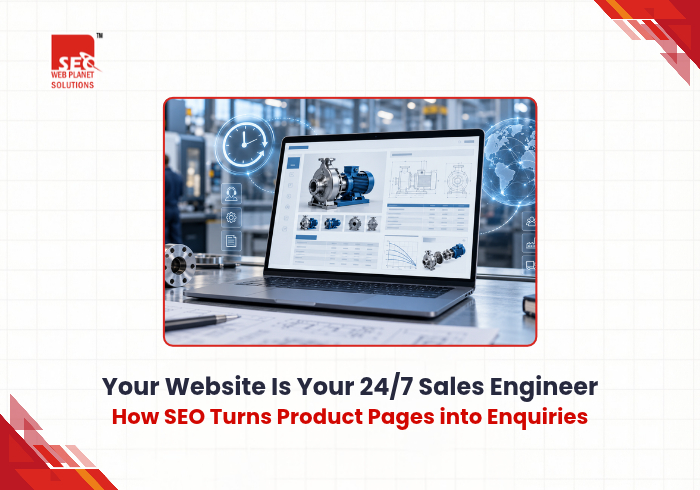
A well-optimised B2B website works like a sales engineer who never sleeps. It answers a buyer’s technical questions, shows specifications and certifications, and captures the RFQ, at 2 a.m. from Dubai or on a Sunday from Houston. B2B website SEO is what brings buyers to those pages in the first place, by matching each product page to the exact searches buyers make.
Most manufacturing websites are built as brochures: a homepage, an About page, a product list and a contact form. They look fine, but they rarely produce enquiries. The difference between a brochure and a sales-engineer website is almost always in the product pages.
What a “Sales Engineer Website” Actually Means
A sales-engineer website answers the questions a buyer would normally ask your technical sales team, before they ask. Think about what your best salesperson does on a call: confirms the grade, explains applications, shares the spec sheet, mentions certifications, discusses packaging and lead time, and asks for the quantity. A good website does all of that on the page.
This matters because buyers now prefer to research on their own first. Gartner found B2B buyers spend about 27% of their buying time researching independently online and only around 17% meeting suppliers. In 6sense’s 2025 study, buyers made first contact with a seller only about 61% of the way through their buying process. Your website is doing the selling for most of the journey.
Why Product Pages Matter More Than Your Homepage
Buyers rarely arrive on your homepage from Google. They search for a product, grade, application or CAS number, and land directly on the page that best matches that search. If that page doesn’t exist, or exists only as a line in a PDF catalogue, Google sends the buyer to a competitor.
In our SEO work for API and specialty chemical manufacturers, product-level searches such as “omeprazole API” or “sodium benzoate manufacturers India” consistently bring better-qualified visitors than broad company-level terms. They are searched by people who already know what they need.
So the first rule of B2B website SEO is simple: every important product, grade or product family should have its own indexable page.
Anatomy of a Product Page That Ranks and Converts
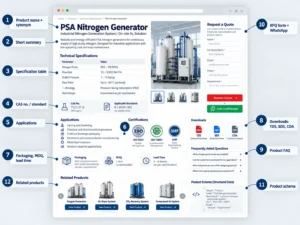
A product page that ranks and converts gives buyers the technical facts they need, gives Google and AI tools clear structured information, and makes the next step easy.
| # | Page element | Why buyers need it | SEO / AI benefit |
|---|---|---|---|
| 1 | H1 with product name + common synonym | Confirms they’re in the right place | Matches the main search term |
| 2 | 2–3 sentence summary at the top | Quick answer: what it is, grade, main use | Easy for Google snippets and AI answers to quote |
| 3 | Specification table | Purity, grade, physical form, standards | Tables are easy for search engines and AI to read |
| 4 | CAS number / HS code / standard | Precise identification | Ranks for exact technical searches |
| 5 | Applications and industries served | Shows fit for their use case | Captures application-based searches |
| 6 | Certifications (ISO, GMP, REACH, FDA etc.) | Compliance and trust | Strong trust (E-E-A-T) signal |
| 7 | Packaging, MOQ, lead time, capacity | Practical buying details | Answers long-tail questions |
| 8 | Downloads: TDS, SDS, COA, brochure | Documents procurement needs | Engagement and return visits |
| 9 | Product FAQ (4–6 questions) | Removes common doubts | FAQPage schema; AEO visibility |
| 10 | RFQ form + WhatsApp + phone | Easy next step | Turns visits into measurable leads |
| 11 | Product schema markup | Not visible to buyers | Helps Google understand the product |
| 12 | Links to related products and industry pages | Helps buyers explore | Spreads authority across the site |
8 Questions Your Website Should Answer Before a Buyer Calls
If your website answers these questions clearly, buyers arrive at the first call ready to discuss quantity and price, not basics.
- Do you make exactly the product, grade or size I need?
- What are the full specifications and test standards?
- Which certifications and approvals do you hold?
- What industries and applications is it used for?
- What is your production capacity and typical lead time?
- What packaging, MOQ and delivery terms do you offer?
- Do you export, and to which countries?
- How quickly can I get a quote or sample, and who will reply?
Common Mistakes That Stop Product Pages From Ranking
The most common reason a manufacturing website gets no enquiries is that its products are not readable by Google in the first place.
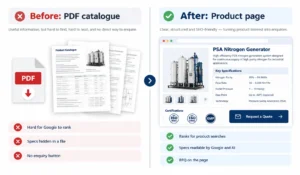
- Products only in a PDF catalogue. Google can index some PDFs, but a downloadable catalogue rarely ranks or converts like a structured product page. Keep the PDF as a download, not as the page.
- One page for all products. A single “Products” page listing 40 items cannot rank for 40 different searches.
- Images instead of text. Specifications shown only in an image cannot be read by search engines or AI tools.
- Thin descriptions. Two lines of marketing copy give buyers and Google nothing to work with.
- No clear next step. If the only enquiry option is a generic Contact page, many buyers leave.
- Slow mobile pages. Many buyers do their first research on a phone; a slow page loses them before they read anything.
Turning Visitors into RFQs
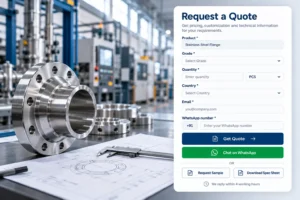
Ranking brings the buyer; the page design decides whether they enquire. Make the next step obvious and low-effort on every product page.
- Short RFQ form on the product page itself: product (pre-filled), grade, quantity, country, email and WhatsApp number. Fewer fields usually mean more submissions.
- WhatsApp click-to-chat button, since many Indian and Middle East buyers prefer it to email.
- Sample or spec-sheet request as a softer option for buyers still comparing.
- Visible response promise, such as “We reply within 4 working hours.” Then keep it.
- Tracking: tag every form, WhatsApp click and phone click in GA4, so you know which product pages actually bring business.
How Strong Product Pages Help You Appear in AI Answers
The same structure that helps buyers also helps AI tools recommend you. When someone asks ChatGPT, Gemini or Google’s AI Overview for suppliers of a product, the AI looks for clear, specific, trustworthy information it can quote.
Pages with a direct summary, specification tables, certifications, FAQs and Product schema are much easier for these systems to understand than a brochure page. Google’s own guidance on structured data explains how Product markup helps it understand product details, and its helpful-content guidance rewards pages written to genuinely answer people’s questions. Consistent company details across your website, directories and Google Business Profile add the trust layer. This is the foundation of AEO and GEO.
Frequently Asked Questions
A clear product name, a short summary, a full specification table, CAS number or standard, applications, certifications, packaging and MOQ, downloadable documents, a short FAQ and an easy RFQ form or WhatsApp button.
Usually because visitors can’t find the technical details they need, or the next step isn’t obvious. Detailed product pages with an RFQ form on the page itself typically convert far better than a generic contact page.
Every important product, grade or product family should. Separate pages let each product rank for its own searches; one combined list page cannot.
They aren’t harmful, but they shouldn’t replace product pages. Keep catalogues as downloads and put the key information in HTML so search engines and AI tools can read it.
Yes. International buyers search by product and specification just like domestic buyers. Adding export details (countries served, Incoterms, export certifications) helps those pages win overseas enquiries.
Want to know why your product pages aren’t bringing enquiries? SEOWebPlanet Solutions will review your website for free, covering product page structure, technical SEO, schema and enquiry flow, and show you exactly what to fix first.
Get your free SEO audit → · or WhatsApp / call +91-7567868483