


SEO vs Trade Shows vs IndiaMART: Where Should a Manufacturer Spend Its Marketing Budget?
In B2B marketing for manufacturers, most companies should not choose just one. Trade shows build relationships, IndiaMART and other marketplaces bring quick but shared enquiries, and SEO builds a long-term source of enquiries you own. If you can fund only one channel that keeps paying back for years, it should be SEO, because it is the only one that keeps working after you stop spending.
Every year, owners and marketing heads face the same question when planning the budget: book another exhibition stall, upgrade the marketplace package, or invest in the website? This guide compares the three honestly, so you can plan B2B marketing for manufacturers based on your products, markets and stage of growth.
The Short Answer: Each Channel Has a Different Job
Think of the three channels as tools for different jobs, not rivals.
- Trade shows are for meeting existing and high-value prospects face to face, launching products and building trust in person.
- IndiaMART and B2B marketplaces are for fast domestic visibility and a steady flow of smaller enquiries, especially when your own website is weak.
- SEO is for being found by new buyers, in India and abroad, at the moment they search for what you make, and for building visibility that compounds over time.
Side-by-Side Comparison of the Three Channels
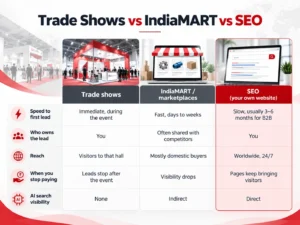
| Factor | Trade shows | IndiaMART / marketplaces | SEO (your own website) |
|---|---|---|---|
| How you pay | One-time per event (stall, travel, samples, staff time) | Annual subscription, often plus paid lead credits | Monthly investment in content, technical work and links |
| Speed to first lead | Immediate, during the event | Fast, days to weeks | Slow, usually 3–6 months for B2B |
| Who owns the lead | You | Often shared with several competing suppliers | You (enquiry comes only to you) |
| Typical lead quality | High (face to face), but limited volume | Mixed, many small or price-only enquiries | High intent, buyer has already read your specs |
| Reach | Visitors to that hall, on those days | Mostly domestic buyers on that platform | Anyone searching on Google or AI tools, worldwide, 24/7 |
| What happens when you stop paying | Leads stop after the event | Listing visibility drops or disappears | Ranked pages keep bringing visitors for months or years |
| Export reach | Only at international fairs, at high cost | Limited | Strong, with export and country pages |
| AI search visibility | None | Indirect (listing may be cited) | Direct, your own pages can be cited by ChatGPT, Gemini and AI Overviews |
| Measurability | Hard, manual lead tracking | Platform dashboard | Full tracking from search to enquiry in GA4 and Search Console |
Trade Shows: Strengths and Limits
Trade shows remain the best place to build trust quickly with serious buyers. A technical buyer can see your product, meet your team and settle doubts in one conversation. For existing customers, they strengthen the relationship.
The limits are reach and cost per conversation. You meet only the people who attend that event, on those days. Stall, travel, samples, printed material and several days of senior staff time add up, and follow-up often happens slowly once the team is back at the plant.
Best for: product launches, meeting known prospects, entering a new region with a strong local fair.
IndiaMART and B2B Marketplaces: Strengths and Limits
Marketplaces give you fast visibility without building your own audience. For a new or small manufacturer, they can bring the first steady stream of domestic enquiries within weeks.
The trade-off is control. You rent visibility on someone else’s platform, often next to direct competitors. The same buyer enquiry may go to several suppliers, which pushes conversations towards price. When the subscription ends, the visibility usually goes with it.
Best for: quick domestic lead flow, standard or commodity products, companies whose own website is not ready yet.
SEO: Strengths and Limits
SEO builds an asset you own: product and capability pages that rank for the searches your buyers make and keep bringing enquiries over time. Because B2B buyers do most of their research before contacting suppliers (Gartner found they spend only about 17% of buying time meeting suppliers), being visible during that research stage matters more each year.
The limit is speed. SEO takes time to build, typically 3–6 months before a B2B manufacturer sees steady enquiries, and it needs consistent work: product pages, technical fixes, content and links. Companies that stop at month 3 usually lose most of the value.
Best for: long-term growth, specialised or technical products, export markets, and companies tired of shared, price-driven leads.
How to Compare Cost per Lead Fairly
Compare channels on cost per qualified lead over 24 months, not cost per lead in the first month. SEO looks expensive early and cheap later; trade shows and marketplaces cost roughly the same every time you use them.
Use this simple formula for each channel:
Cost per qualified lead = total spend in the period ÷ number of qualified enquiries in the period
Count only enquiries that match your product, quantity and market, not every form fill or marketplace ping.
Illustrative example (not a guarantee): a manufacturer invests ₹40,000 per month in SEO.
| Period | Spend | Qualified organic enquiries | Cost per enquiry |
|---|---|---|---|
| Months 1–3 | ₹1,20,000 | 2 | ₹60,000 |
| Months 4–6 | ₹1,20,000 | 15 | ₹8,000 |
| Months 7–12 | ₹2,40,000 | 60 | ₹4,000 |
| Months 13–24 | ₹4,80,000 | 180 | ₹2,667 |
| Total, 24 months | ₹9,60,000 | 257 | ≈ ₹3,735 |
The first quarter alone would make SEO look like a poor channel. Across two years, the same investment becomes one of the cheapest, and the pages keep working into year three. Your own numbers will differ by product, competition and market, so track them from day one.
<dir=”ltr”>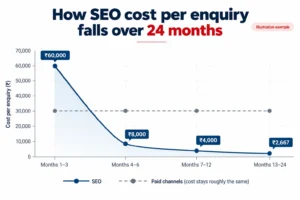
A Sensible Budget Mix by Company Stage
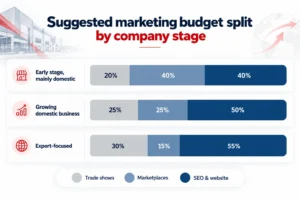
The right split depends on where your business is today. Treat these as starting points, then shift money towards whichever channel shows the lowest cost per qualified lead after 12 months.
| Company stage | Trade shows | Marketplaces | SEO & website |
|---|---|---|---|
| Early stage, mainly domestic, weak website | 20% | 40% | 40% |
| Growing, established domestic customer base | 25% | 25% | 50% |
| Export-focused or entering export | 30% (international fairs) | 15% | 55% (incl. export pages) |
How the Three Channels Work Better Together
The strongest manufacturers use each channel to support the others.
- After a trade show, visitors search for your company and products online. A strong website with detailed product pages turns that interest into enquiries instead of losing it.
- Your marketplace profile should link to your website and use the same product names, specifications and company details. Consistent details also help AI tools trust your business.
- Your website content (specification pages, certifications, case studies) can be reused as fair brochures, marketplace descriptions and sales follow-up material.
- Over time, many companies find that SEO lets them reduce marketplace spend, because more buyers come directly.
Frequently Asked Questions
They do different jobs. IndiaMART gives faster, shared domestic enquiries; SEO gives slower-starting but exclusive enquiries from India and abroad that continue after you stop paying. Most manufacturers benefit from running both, then shifting budget towards SEO as it matures.
Yes, for relationship-building, product launches and meeting high-value prospects. Their limit is reach — they only cover the buyers present at that event — so they work best alongside an online presence.
common starting point is 40–55% on SEO and the website, with the rest split between trade shows and marketplaces, depending on your stage and export focus. Review the split every 12 months using cost per qualified lead.
For many B2B manufacturers, SEO cost per lead starts falling noticeably after 6–12 months, as more pages rank and enquiries grow while the monthly investment stays flat.
Yes. International buyers you meet at fairs will check your website before ordering, and export-focused pages help new international buyers find you without travelling to an exhibition.
Not sure where your budget will work hardest? SEOWebPlanet Solutions offers a free SEO audit for manufacturers. We’ll show you which product searches you could win, what your competitors rank for, and what a realistic 12-month plan looks like.
Get your free SEO audit → · or WhatsApp / call +91-7567868483