


Complete SEO, AEO & GEO Website Optimization Checklist for 2027: 25 Essential Steps With Examples
Key takeaways
- SEO, AEO and GEO are overlapping practices, not three separate Google algorithms. Google says its AI features (AI Overviews and AI Mode) run on the same core ranking and quality systems as regular Search.
- A page must be indexed and eligible to show a snippet before it can appear in Google’s AI features. There is no special AI markup, file or “chunking” trick.
- Original, first-hand content (real specs, real projects, named experts) is the strongest long-term signal for both rankings and AI citations.
- Measure qualified enquiries, not just impressions. Search Console now has a Generative AI performance report for AI Overviews and AI Mode impressions.
Introduction: why one checklist now covers SEO, AEO and GEO
A website can be technically sound and still fail to win qualified enquiries. In 2027, buyers find suppliers through classic blue links, Google’s AI Overviews and AI Mode, ChatGPT search, Perplexity and Microsoft Copilot – often all in the same week. A practical strategy therefore has to connect three ideas:
- SEO (Search Engine Optimization): making pages crawlable, indexable, relevant and trustworthy so they rank in search results.
- AEO (Answer Engine Optimization): structuring content so it answers real questions clearly and directly.
- GEO (Generative Engine Optimization): making your brand and content easy for AI assistants to find, understand, cite and describe accurately.
The scale of AI search is no longer a side issue. Alphabet has said AI Overviews grew from about 1.5 billion monthly users in May 2025 to over 2 billion by July 2025, and executives cited more than 2.5 billion by mid-2026. AI Mode passed 1 billion monthly active users within roughly a year of its global expansion.
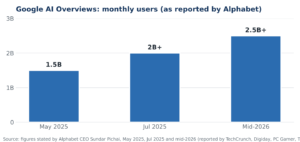
Figure 1: Google AI Overviews monthly users, as stated by Alphabet’s CEO.
This 25-step checklist is written for B2B manufacturers, exporters, service providers and growing businesses. Use it as a working audit, not a promise of rankings: search results and AI citations depend on many systems outside a website owner’s control.
SEO vs AEO vs GEO at a glance
| SEO | AEO | GEO | |
|---|---|---|---|
| Main goal | Rank and earn clicks from search results | Be the clearest, most reliable answer to a question | Be found, cited and described correctly by AI assistants |
| Where it shows | Google and Bing organic results | Featured snippets, AI Overviews, voice answers | AI Overviews, AI Mode, ChatGPT search, Perplexity, Copilot |
| Core work | Crawling, indexing, relevance, links, page experience | Question research, answer-first writing, tables, clear structure | Entity consistency, original evidence, third-party mentions, AI crawler access |
| How to measure | Clicks, rankings, organic leads | Query coverage, engagement with answer sections | Search Console Generative AI report, prompt logs, AI referrals, CRM leads |
| Shared foundation | Indexable, helpful, people-first content from a trustworthy source | ||
How to use this checklist
Work through the five sections in order: technical issues block everything else. Mark each step Done, In progress or Not applicable, and fix the items affecting your highest-value service or product pages first.
1. Technical SEO: make important pages discoverable
| Step | Action | Verification / tool |
|---|---|---|
| 1. Indexing & crawl directives | Check page indexing, robots.txt, XML sitemap and page-level noindex rules. | Google Search Console (GSC) Page indexing report, URL Inspection |
| 2. Crawl errors | Resolve important 404s, redirect chains and broken internal links. | Screaming Frog, GSC |
| 3. Page experience | Bring LCP, INP and CLS into the “good” range on key mobile templates. | PageSpeed Insights, GSC Core Web Vitals report |
| 4. JavaScript rendering | Confirm primary text and links appear in the rendered HTML. | URL Inspection (View crawled page), Chrome DevTools |
| 5. Structured data | Implement only applicable, accurate schema types that match visible content. | Rich Results Test, Schema Markup Validator |
Example: reading the indexing gap correctly
An industrial packaging website lists 120 URLs in its sitemap, but GSC reports only 85 indexed. Do not assume the other 35 are errors. Segment them: duplicates, intentional noindex pages (thank-you, login), redirects, and important product pages excluded unexpectedly. Here, only 9 were genuine product pages – those are the ones to fix first.
Illustrative scenario, not client data.
2. On-page SEO: align each page with the buyer’s intent
| Step | Action | Example |
|---|---|---|
| 6. Intent mapping | Assign one primary intent and topic per priority URL. | “FIBC bags manufacturer” -> manufacturer/product landing page, not a blog post |
| 7. Metadata & linking | Write unique titles, useful H1s and contextual internal links. | Link “U-panel bags” from the FIBC category page |
| 8. Freshness | Update facts, specifications and dated claims when they change. | Review manufacturing capacity and certificate validity every quarter |
| 9. Original evidence | Add first-hand photos, verified data, expert insights and case studies. | Show actual testing or production workflow with real photos |
| 10. Quality review | Consolidate repetitive, thin or unverified AI-generated pages. | Merge three overlapping articles answering the same question into one |
Example: fixing a weak product page title
Before: “Products”
After: “FIBC Bulk Bags Manufacturer | Types, Specifications & Enquiry”
Then add verified capacity, dimensions, applications, packaging options, buyer FAQs and a request-for-quotation (RFQ) form. Never invent certifications or performance figures.
3. AEO: give clear, reliable answers
| Step | Action | Example |
|---|---|---|
| 11. Direct answers | Answer the question in the first one or two sentences under its heading. | “What is an FIBC bag?” -> concise definition first |
| 12. Helpful formats | Use comparisons, step lists and tables where they genuinely help. | U-panel vs circular FIBC construction table |
| 13. Structure | Use descriptive, question-style headings and accessible HTML. | H2: “Which FIBC type suits food ingredients?” |
| 14. Source quality | Support technical or regulated claims with credible references. | Cite the relevant testing standard or manufacturer documentation |
| 15. Company clarity | Keep services, contact details and locations accurate everywhere, including Google Business Profile. | Same name, address, phone and service list on website, GBP and directories |
Example: an answer block that works for readers and AI
Q: What is an FIBC bag?
An FIBC (flexible intermediate bulk container) is a large woven polypropylene bag used to store and transport dry, flowable materials such as grains, chemicals and minerals. The right type depends on the material, safe working load, filling and discharge method, and any industry requirements such as food-grade or anti-static construction.
Follow this with a specification table and a clear enquiry path. The block is useful to buyers even if no AI answer ever cites it – which is exactly why it tends to get cited.
4. GEO: improve discoverability in generative search
| Step | Action | How to evaluate |
|---|---|---|
| 16. AI visibility tests | Test a fixed set of realistic category and brand prompts every month. | Log platform, date, location, exact prompt, brands mentioned and cited URLs |
| 17. Accessible content | Keep important pages public and readable; confirm your site is not opted out of Search generative AI features in Search Console; allow the AI search crawlers you want (e.g. OAI-SearchBot, PerplexityBot). | Review robots.txt, Search Console settings and rendered content |
| 18. Entity consistency | Use one consistent company name, description and service list. | Compare website, LinkedIn, GBP, IndiaMART/TradeIndia and industry profiles |
| 19. Third-party evidence | Earn legitimate mentions in relevant publications, associations and directories. | Track editorial citations and referring domains |
| 20. Referral measurement | Measure AI impressions, AI referrals and assisted conversions. | GSC Generative AI report, GA4 referral segments, CRM source fields |
Example: two GEO scenarios
International: an industrial automation company wants discovery for “PLC migration specialists in the US”. It builds a focused service page covering supported PLC platforms, migration process, downtime planning, documented projects and service geography, then earns coverage in a trade publication.
India: a Vadodara-based API manufacturer wants to appear when buyers ask an AI assistant for “WHO-GMP certified API manufacturers in Gujarat”. It publishes a verified product list with CAS numbers, regulatory approvals it actually holds, DMF status and export markets, and keeps the same facts on its directory listings.
In both cases the team reruns the same prompts monthly. AI answers vary, so mention frequency is a directional signal, not a ranking.
Illustrative scenarios, not client case studies.
5. Authority and performance: connect search to business outcomes
| Step | Action | Measure |
|---|---|---|
| 21. Credibility (E-E-A-T) | Show real authors, qualified reviewers, company history and verifiable evidence. | Author pages, accurate testimonials, case studies with permission |
| 22. Links & PR | Earn relevant editorial backlinks; review spam risks. | Referring domains and topical relevance |
| 23. Analytics | Configure GSC, GA4 and lead conversion events (forms, calls, WhatsApp clicks). | Form submissions, calls and qualified RFQs |
| 24. Outcome KPIs | Separate branded and non-branded performance and track lead quality. | Clicks, qualified leads, conversion rate, pipeline value |
| 25. Monthly review | Review technical, content and AI visibility findings together. | Prioritized action log and trend report |
Before and after: an FIBC product landing page
| Element | Before | Optimized approach |
|---|---|---|
| Page title | Products | FIBC Bulk Bags Manufacturer | Product Types & RFQ |
| Content | Two generic paragraphs | Verified specifications, applications and buyer FAQs |
| Internal links | No category links | Links to construction types and industry applications |
| Trust | Unsubstantiated “best quality” claims | Actual facility photos and verified certificates |
| Conversion | Generic contact link | Visible RFQ form and WhatsApp enquiry button |
| Measurement | Only sessions tracked | Organic landing-page enquiries and qualified RFQs |
This illustrates a recommended implementation, not measured client results. Record a baseline and compare like-for-like periods before making any performance claim.
Tools for a 2027 optimization workflow
| Tool | Best use | Practical output |
|---|---|---|
| Google Search Console | Indexing, queries, performance, Generative AI report | Excluded-page triage, priority query list, AI impression trend |
| Bing Webmaster Tools | Bing indexing (Bing also supports Microsoft Copilot answers) | Bing crawl issues and query data |
| Screaming Frog | Crawls, canonicals, links, metadata | Technical issue inventory |
| PageSpeed Insights / CrUX | Field and lab performance | Template-level Core Web Vitals priorities |
| GA4 + Looker Studio | Engagement, events and reporting | Leads-by-channel dashboard |
| Semrush / Ahrefs | Competitor and keyword research | Content-gap and backlink opportunities |
| Rich Results Test | Google-supported structured data | Validation errors and warnings |
| Google Business Profile | Local and brand information | Consistent entity data for local and AI results |
| Manual AI prompt tests | Qualitative brand discoverability checks | Prompt log of mentions and citations |
Suggested 90-day implementation plan
| Period | Focus | Deliverables |
|---|---|---|
| Days 1-30 | Baseline, crawling, indexing and analytics | Technical audit, KPI baseline, AI prompt baseline, prioritized backlog |
| Days 31-60 | Fix templates; optimize key service/product pages | Indexing fixes, on-page revisions, answer blocks, internal links |
| Days 61-90 | Original evidence, authority and measurement | Case study, citation outreach, second prompt test, reporting review |
Common mistakes to avoid
- Selling AEO or GEO as guaranteed AI placement.
- Buying “AI hacks” Google says you can ignore – llms.txt files for Google Search, splitting content into artificial chunks, or AI-specific rewrites.
- Blocking essential pages, or relying on schema markup to compensate for weak content.
- Publishing large volumes of AI text without expert validation or original value.
- Leaving Google Business Profile and directory details inconsistent with the website.
- Optimizing for impressions while ignoring qualified leads and revenue.
Frequently Asked Questions
Yes. Google states that its AI features are built on the same core ranking and quality systems as Search, and a page must be indexed and snippet-eligible to appear in them. AI search adds new discovery surfaces; it does not remove the need for SEO.
Not directly. Google stopped showing FAQ rich results for all sites on 7 May 2026. FAQPage markup is still valid vocabulary and does no harm, but Google says no special structured data is needed for AI Overviews or AI Mode. Write genuinely useful FAQs for readers instead.
Not for Google. Google’s July 2026 guide on generative AI features says Google Search does not use llms.txt or similar AI text files, so they neither help nor hurt there. Other platforms may treat them differently; check each provider’s documentation.
Monitor critical errors continuously where feasible, review search and conversion performance monthly, and run a deeper technical and content audit quarterly or after any major site change or migration.
Combine the Search Console Generative AI report (impressions in AI Overviews and AI Mode), a stable monthly prompt log, identifiable AI referral traffic in GA4 and qualified enquiries in your CRM. Treat the results as directional: AI answers are personalized and change over time.
Conclusion
The strongest 2027 search strategy is not a choice between SEO, AEO and GEO. It is one disciplined website program: make key pages crawlable, answer real buyer questions, publish verifiable expertise, build relevant authority and measure business outcomes. Start with the highest-value pages, document every change and improve based on evidence.
Ready to find your gaps?
Want to know which of these 25 steps your website needs most? Request a Website SEO, AEO & GEO Audit from SEOWebPlanet Solutions – you will get a prioritized action list for your top service and product pages.
About SEOWebPlanet Solutions
SEOWebPlanet Solutions is a Vadodara, Gujarat-based digital marketing agency with 13+ years of experience serving B2B, B2C and D2C brands across India and international markets. Services include SEO, AEO and GEO, website design and development, PPC and paid social, social media marketing, email and WhatsApp marketing, lead generation and corporate branding.
Sources cited in this article (checked November 2026)
- Google: AI features and your website – developers.google.com/search/docs/appearance/ai-features
- Google: Optimizing your website for generative AI features on Google Search (updated July 2026) – developers.google.com/search/docs/fundamentals/ai-optimization-guide
- Google Search Central blog: Search Generative AI performance reports (3 June 2026)
- Google FAQPage structured data documentation – deprecation notice dated 7 May 2026
- AI Overviews and AI Mode user figures: Alphabet CEO remarks (Q2 2025 and Q2 2026 earnings), reported by TechCrunch, Digiday and PC Gamer