


What is Lead Generation in Digital Marketing? A Complete Guide for Business Owners
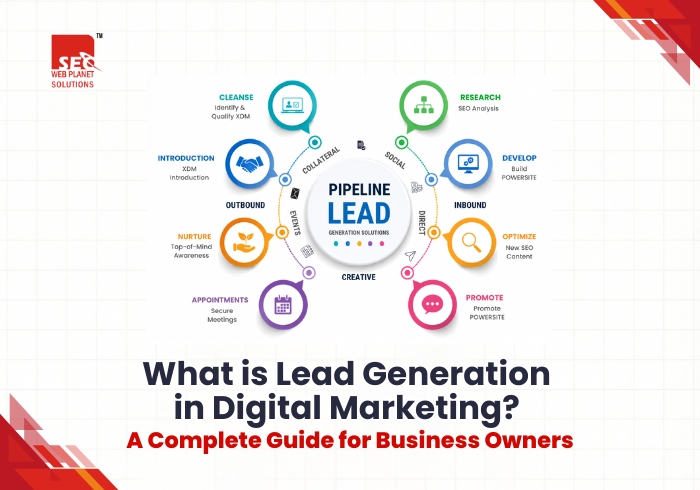
Every business, regardless of size or industry, depends on one thing to survive and grow: a steady stream of potential customers. In the digital marketing world, this process has a name lead generation. If you have ever wondered why your competitors always seem to have a full sales pipeline while you are still chasing referrals, the answer almost always comes down to how well they understand and execute lead generation.
In this guide, we will break down exactly what lead generation in digital marketing means, explore proven lead generation strategies, explain the difference between inbound and outbound approaches, share practical lead magnet ideas, and look closely at how B2B lead generation works for businesses in India.
By the end, you will have a clear, actionable understanding of how to turn your website and digital presence into a consistent lead-generating asset for your business.
What is Lead Generation in Digital Marketing?
Lead generation is the process of attracting strangers and prospects to your business and converting them into people who have expressed interest in your company’s product or service. In digital marketing, this typically happens by capturing a potential customer’s contact information usually their name, email address, or phone number in exchange for something of value, such as a free guide, consultation, or discount.
A “lead” is simply a person or organization that has shown some level of interest in what you offer, but has not yet become a paying customer. Lead generation is the bridge between awareness (someone discovering your business) and conversion (someone becoming a paying customer).
Digital marketing channels used for lead generation typically include:
- Search Engine Optimization (SEO)
- Pay-Per-Click (PPC) advertising
- Content marketing (blogs, ebooks, whitepapers)
- Email marketing
- Social media marketing
- Landing pages and lead capture forms
- Webinars and online events
According to Wikipedia’s overview of Lead Generation, the term originated in traditional marketing and has since evolved significantly with the rise of digital channels, which now allow for far more precise targeting, tracking, and personalization of the lead generation process than was ever possible through traditional advertising alone.
Why Lead Generation Matters for Your Business
Without a structured lead generation process, businesses are forced to rely on word-of-mouth, cold outreach, or expensive, unpredictable advertising bursts. A well-built lead generation system gives you:
- Predictability — a consistent flow of prospects entering your sales pipeline
- Lower cost per acquisition — organic and inbound methods are significantly cheaper than traditional advertising over time
- Better quality prospects — people who find you through search or content are often already interested, making them easier to convert
- Scalability — once a lead generation system is built and optimized, it can be scaled with budget and content investment
Our team has seen firsthand how a focused SEO strategy transforms a website from a digital brochure into an active lead-generating machine, bringing in qualified prospects around the clock without the unpredictability of outbound cold calling.
Inbound Lead Generation vs Outbound Lead Generation
Understanding the difference between these two approaches is foundational to any digital marketing strategy.
Outbound Lead Generation
Outbound lead generation involves proactively reaching out to potential customers who have not yet expressed interest in your business. This includes cold calling, cold emailing, traditional advertisements, and leaflet distribution. While still used in some industries, outbound methods have become significantly less effective and more expensive as consumers increasingly ignore interruption-based marketing.
Inbound Lead Generation
Inbound lead generation flips the model. Instead of chasing prospects, you create valuable content and experiences that naturally attract potential customers to you. The customer initiates contact because they found your content, your website, or your social media useful and relevant to their needs.
Inbound lead generation typically follows four stages:
- Attract — bring strangers to your website through SEO, content marketing, and social media
- Convert — turn visitors into leads using forms, landing pages, and lead magnets
- Close — nurture leads through email marketing and sales follow-up until they become customers
- Delight — continue providing value post-purchase so customers become repeat buyers and brand advocates
Inbound lead generation is widely considered more sustainable and cost-effective in 2026 because it builds long-term organic visibility rather than relying on one-time interruptions.
Proven Lead Generation Strategies for 2026
Here are the lead generation strategies that consistently deliver results for businesses across industries:
1. Search Engine Optimization (SEO)
SEO remains one of the most cost-effective, long-term lead generation strategies available. By ranking your website for keywords your potential customers are actively searching for, you generate a continuous stream of high-intent organic leads without ongoing ad spend. This includes optimizing landing pages, blog content, and local search presence to capture demand at every stage of the buyer’s journey.
2. Pay-Per-Click (PPC) Advertising
PPC campaigns on Google Ads and social platforms allow you to generate leads quickly while your organic SEO efforts build momentum in the background. PPC is particularly effective for capturing high-intent, transactional search queries. Explore our Lead Generation PPC Management services to see how a well-structured campaign can deliver leads from day one.
3. Content Marketing
Publishing blogs, guides, case studies, and videos that answer your audience’s real questions builds trust and positions your brand as an authority. Quality content is also the foundation that fuels both SEO and lead magnet strategies.
4. Landing Page Optimization
A dedicated, conversion-focused landing page with a clear value proposition, minimal distractions, and a strong call-to-action consistently outperforms generic website pages when it comes to converting traffic into leads.
5. Email Marketing and Nurture Sequences
Not every lead is ready to buy immediately. Automated email nurture sequences keep your brand top-of-mind and gradually move prospects down the funnel until they are sales-ready.
6. Social Media Lead Generation
Platforms like LinkedIn, Facebook, and Instagram now offer native lead generation ad formats that allow users to submit their information without ever leaving the platform, significantly reducing friction in the conversion process.
7. Webinars and Virtual Events
Hosting educational webinars positions your business as an expert while naturally collecting attendee information a particularly effective strategy for B2B and service-based businesses.
Lead Magnet Ideas That Actually Convert
A lead magnet is the value exchange that convinces a visitor to share their contact information. The most effective lead magnets solve a specific, immediate problem for your target audience. Here are proven lead magnet ideas across industries:
- Free eBooks or Guides — in-depth resources on a topic your audience cares about (e.g., “The Complete Guide to Choosing a Digital Marketing Agency”)
- Checklists and Templates — quick, actionable resources people can implement immediately (e.g., an SEO audit checklist)
- Free Tools or Calculators — interactive tools like an ROI calculator or pricing estimator tend to generate exceptionally high conversion rates
- Webinars and Masterclasses — live or recorded sessions that deliver deep value in exchange for registration
- Free Consultations or Audits — particularly effective for service-based and B2B businesses, as it allows direct interaction with a sales-qualified prospect
- Case Studies and Whitepapers — especially powerful for B2B audiences who need data-backed proof before engaging
- Discount Codes or Free Trials — highly effective for e-commerce and SaaS businesses
- Quizzes and Assessments — interactive content that personalizes the experience while capturing contact details
Pro Tip: The best lead magnet is hyper-specific to a single pain point. A generic “Subscribe to our newsletter” offer converts far worse than “Get our 2026 SEO Checklist for Local Businesses.”
B2B Lead Generation in India: What Makes It Different
B2B lead generation in India comes with its own unique dynamics compared to B2C or even B2B markets in other countries. Understanding these nuances is essential for building an effective strategy.
Key Characteristics of B2B Lead Generation in India
- Longer sales cycles — Indian B2B buyers typically involve multiple stakeholders and decision-makers, meaning the journey from lead to customer can take weeks or months
- Relationship-driven decisions — trust and credibility play an outsized role; case studies, testimonials, and referrals carry significant weight
- Price sensitivity combined with value focus — Indian B2B buyers often compare multiple vendors thoroughly before committing, making clear value communication essential
- Growing digital adoption — even traditional B2B sectors like manufacturing, logistics, and industrial services are increasingly searching for vendors online, creating major opportunities for businesses with strong digital visibility
- LinkedIn as a primary channel — LinkedIn has become the dominant platform for B2B lead generation in India, particularly for service-based, SaaS, and consulting businesses
Effective B2B Lead Generation Tactics for the Indian Market
- LinkedIn outreach and content marketing — building authority through regular posting and direct, personalized outreach to decision-makers
- Industry-specific SEO — ranking for highly specific B2B search terms relevant to your sector (e.g., “industrial equipment suppliers in Gujarat”)
- Email marketing to segmented lists — personalized sequences based on industry, company size, and stage in the buyer’s journey
- Trade directories and B2B marketplaces — platforms like IndiaMART and TradeIndia remain highly relevant for Indian B2B discovery
- Webinars and downloadable resources — particularly effective for complex products or services that require education before purchase
- Local SEO for regional B2B businesses — many Indian B2B buyers search with location-specific intent, making local optimization critical
How to Build a Lead Generation Funnel: Step by Step
- Define your Ideal Customer Profile (ICP) — understand exactly who you are trying to attract before creating any content or campaign
- Create a compelling lead magnet — offer genuine value relevant to your ICP’s specific pain points
- Build a high-converting landing page — keep it focused, with one clear call-to-action
- Drive targeted traffic — through SEO, PPC, social media, or a combination of channels
- Capture and segment leads — use forms and CRM tools to organize leads by interest and intent
- Nurture with email automation — guide leads through the funnel with relevant, value-driven content
- Hand off sales-ready leads — ensure a smooth transition from marketing to sales for final conversion
- Measure and optimize continuously — track conversion rates at every stage and refine based on data
Lead Generation Checklist for Business Owners
- [ ] Define your Ideal Customer Profile (ICP)
- [ ] Audit your website for lead capture opportunities (forms, CTAs, landing pages)
- [ ] Create at least one high-value lead magnet
- [ ] Optimize your top service pages for relevant search keywords
- [ ] Set up a basic CRM to track and segment leads
- [ ] Launch an email nurture sequence for new leads
- [ ] Test one paid advertising channel alongside organic efforts
- [ ] Review and optimize landing page conversion rates monthly
- [ ] For B2B businesses, build out a LinkedIn content and outreach strategy
Lead Generation: Key Takeaways
Understanding what lead generation in digital marketing truly means is the first step toward building a business that doesn’t depend on luck or referrals alone. Whether you focus on inbound lead generation through SEO and content, run targeted PPC campaigns, design high-converting lead magnets, or build out a dedicated B2B lead generation strategy for the Indian market, the principle remains the same: attract the right people, offer genuine value, and guide them smoothly toward becoming customers.
The businesses that consistently win are the ones that treat lead generation not as a one-time campaign, but as an ongoing system refined, measured, and improved month after month.
Ready to build a predictable lead generation system for your business? Get in touch with the SEOWebPlanet team we help businesses across India, Canada, and the USA turn their digital presence into a consistent source of qualified leads.
A lead is anyone who has shown initial interest in your business, typically by sharing their contact information through a form, download, or sign-up. A prospect is a lead that has been qualified meaning they fit your ideal customer profile and have demonstrated genuine buying intent. Essentially, every prospect was once a lead, but not every lead becomes a prospect.
This depends heavily on the channel. PPC advertising can generate leads within days of launch, while SEO-driven lead generation typically takes 3–6 months to build meaningful organic traffic and conversions. Content marketing and inbound strategies generally take longer to gain traction but tend to produce more sustainable, lower-cost leads over time. A combined strategy that uses PPC for immediate results while SEO builds in the background is often the most effective approach.
Average landing page conversion rates across industries typically range between 2% and 5%, though highly optimized pages with strong offers can achieve 10% or higher. B2B lead generation campaigns often see lower volume but higher quality leads, while B2C campaigns may see higher volume with more variation in lead quality. The right benchmark depends on your industry, offer, and traffic source, so it’s important to track your own baseline and improve incrementally.
Neither is inherently “better” they serve different purposes. PPC advertising delivers immediate, predictable lead volume but stops generating leads the moment you stop paying. SEO takes longer to build but generates compounding, long-term organic leads at a significantly lower cost per acquisition over time. Most successful lead generation strategies combine both: PPC for immediate pipeline while SEO investment grows in the background.
B2B lead generation typically involves longer sales cycles, multiple decision-makers, and a stronger emphasis on building trust through case studies, data, and relationship-driven content. B2C lead generation, on the other hand, usually involves shorter decision cycles, more emotionally-driven messaging, and a single decision-maker. In India specifically, B2B lead generation often leans heavily on LinkedIn, industry-specific SEO, and trade platforms, while B2C tends to focus more on social media and paid advertising.
While not strictly mandatory for very small businesses, a CRM (Customer Relationship Management) tool becomes essential as your lead volume grows. It allows you to track where each lead came from, their engagement history, and their position in your sales funnel, ensuring no opportunity falls through the cracks. Most digital marketing strategies for lead generation work best when paired with a CRM to properly nurture and convert leads over time.
Small businesses with limited budgets should prioritize cost-effective, high-ROI channels first: local SEO, Google Business Profile optimization, organic social media content, and a simple lead magnet on a focused landing page. These methods require more time investment than monetary investment, making them ideal starting points before scaling into paid advertising as revenue grows.