


Off-Page SEO Techniques That Still Work in 2026
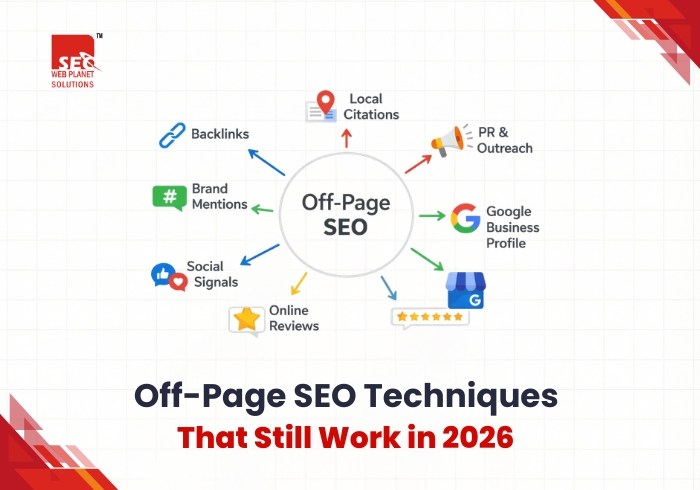
Search engine optimization is no longer just about what happens on your website. In 2026, the battle for Page 1 is largely won or lost outside your domain. Off-page SEO techniques remain a critical pillar of any strong digital marketing strategy, and while some tactics from five years ago are now obsolete, many powerful methods have evolved and are working better than ever.
Whether you are a business owner trying to grow your organic presence or a digital marketer managing multiple clients, understanding which off-page SEO techniques deliver real results in 2026 is non-negotiable.
In this guide, we break down every major off-page SEO method that still works, explain why it works, and show you how to execute it effectively.
What Is Off-Page SEO? (And Why It Still Matters in 2026)
Off-page SEO refers to all the actions taken outside your own website to influence your rankings in search engine results pages (SERPs). While on-page SEO optimizes your content and structure, off-page SEO builds your site’s authority, credibility, and trustworthiness in the eyes of Google and other search engines.
Google’s core ranking systems still rely heavily on external signals, primarily backlinks, to judge whether a page deserves to rank. According to Wikipedia’s overview of Search Engine Optimization, off-page factors including link-based signals have been a foundational part of how search engines evaluate relevance since the earliest days of the web.
The bottom line: even in 2026, with AI-driven search updates, helpful content systems, and E-E-A-T signals, off-page SEO is not dead it has simply matured.
1. Link Building Strategies That Still Work
Link building remains the single most impactful off-page SEO technique. But the days of mass directory submissions and private blog networks (PBNs) are firmly in the past. Modern link building strategies focus on earning links that are editorially placed, contextually relevant, and genuinely hard to replicate.
a) Skyscraper Technique (Updated for 2026)
Find the best-ranking content on a target topic, create something demonstrably more thorough, updated, and useful, then reach out to sites already linking to the original piece. The technique has evolved now you must also ensure your content satisfies AI Overviews and featured snippet formats.
b) Resource Page Link Building
Many authoritative websites maintain “resources” or “useful links” pages. Identify these pages in your niche, create a genuinely useful asset (a tool, guide, or dataset), and pitch it for inclusion. Conversion rates are higher than cold guest post outreach because these pages exist to link out.
c) Broken Link Building
Use tools like Ahrefs or Screaming Frog to find broken external links on high-authority pages in your niche. Reach out to the webmaster, flag the dead link, and suggest your relevant content as a replacement. It’s a win-win with a high acceptance rate.
d) Link Insertions (Niche Edits)
Rather than writing a new guest post, you identify existing high-authority articles and request that your link be naturally inserted into the body content. When done on genuinely relevant, high-quality pages, this is one of the fastest ways to acquire strong backlinks.
e) Competitor Backlink Analysis
Using tools like SEMrush or Ahrefs, export the backlink profile of your top-ranking competitors. Identify patterns which sites link to multiple competitors but not to you? Those are your highest-priority targets.
Pro Tip: Quality always beats quantity. Ten links from DA 50+ relevant sites outperform 500 links from low-quality directories every time.
2. Domain Authority: How to Build It Sustainably
Domain Authority (DA) — a metric developed by Moz is a score from 1 to 100 that predicts how well a site is likely to rank. While Google does not use DA directly, the underlying signals it measures (backlink quality, link diversity, trustworthiness) absolutely influence rankings.
Building domain authority in 2026 requires a multi-channel approach:
- Diversify your backlink profile — earn links from blogs, news outlets, government sites, educational institutions, and directories. A natural link profile includes varied anchor text and varied referring domains.
- Eliminate toxic backlinks — regularly audit your link profile and disavow spammy or irrelevant links that could drag your authority down.
- Internal linking — your internal link structure passes authority (PageRank) across your site. A well-linked website amplifies the value of every external link you earn. Learn how our SEO services are designed to strengthen both your internal and external link architecture.
- Consistency — authority is not built overnight. A consistent content and outreach program over 6–12 months moves the needle far more than sporadic bursts of activity.
3. Digital PR: The Most Powerful Off-Page Technique of 2026
If there is one off-page SEO technique that has grown the most in importance over the past two years, it is digital PR. Unlike traditional PR, digital PR is specifically engineered to earn high-authority editorial backlinks from major publications, news sites, and industry media.
How Digital PR Works for SEO
Digital PR involves creating genuinely newsworthy content original research, data studies, surveys, provocative opinion pieces, or expert commentary and distributing it to journalists and editors at top-tier publications. When they cover your story, they naturally link back to your site as the source.
Why Google Loves Digital PR Links
Links from the BBC, Forbes, The Guardian, major industry outlets, or reputable news aggregators carry enormous trust signals. These are links that cannot be bought (easily), cannot be automated, and are nearly impossible to replicate. They tick every box Google’s quality raters look for: E-E-A-T (Experience, Expertise, Authoritativeness, Trustworthiness).
Digital PR Tactics for 2026
- Original data and surveys — publish a survey of 500+ people in your industry and pitch the findings to journalists. Data driven stories are consistently picked up.
- Reactive PR / Newsjacking — when a trending story breaks in your industry, position yourself or your client as a quotable expert within hours. Journalists on deadline love ready made commentary.
- Expert quote outreach — platforms like HARO (Help A Reporter Out) or its successors connect you with journalists actively seeking expert sources. A good quote can land a link from a major outlet with zero content creation cost.
- Local digital PR — even local or regional publications carry strong signals for local SEO. A business featured in a city news outlet with a .org or well established domain gains significant trust equity.
4. Brand Mentions: Turning Unlinked References Into SEO Gold
Brand mentions — both linked and unlinked have become a recognized off-page SEO signal. Google’s systems are sophisticated enough to identify when authoritative content references your brand, even without a hyperlink, and factor this into trust calculations.
Why Unlinked Brand Mentions Matter
Think of unlinked mentions as “implied links.” If 50 reputable websites reference “SEOWebPlanet” in the context of digital marketing expertise, Google’s entity recognition systems interpret this as a trust signal even if none of those pages include a clickable link.
How to Generate and Leverage Brand Mentions
Step 1 — Monitor mentions: Use Google Alerts, Mention.com, or Ahrefs Alerts to track every time your brand is mentioned online.
Step 2 — Convert unlinked mentions: When you find an article that mentions your brand without a link, reach out politely to the author or editor and request that the mention be turned into a hyperlink. Conversion rates are high because you are asking for something small they have already written about you.
Step 3 — Build mention-worthy assets: Infographics, original data reports, free tools, and unique frameworks generate organic brand mentions far more than generic blog posts.
Step 4 — Thought leadership: Publishing opinion articles, contributing to industry roundups, and appearing on podcasts creates brand mentions across formats that collectively strengthen your online entity presence.
5. Guest Posting (Done the Right Way)
Guest posting is not dead low quality, scaled, keyword-anchor-stuffed guest posting is dead. High-quality guest posts on genuinely relevant, editorially rigorous publications remain one of the most reliable link building strategies available.
What “done right” looks like in 2026:
- Target sites with genuine organic traffic (verify in SEMrush/Ahrefs), not just high DA scores
- Pitch original angles, not recycled topics
- Write for the audience of the host site not just to slip in a backlink
- Use natural, branded, or partial-match anchor text
- Limit guest posting to a fraction of your total link building activity it should complement, not dominate, your strategy
6. Social Signals and Content Amplification
Social media links are “nofollow” they do not pass direct link equity. However, social signals matter indirectly in 2026:
- Content that gets widely shared on LinkedIn, X (Twitter), or Reddit tends to get picked up by bloggers and journalists, generating dofollow links organically
- Social engagement signals user interest, which can improve click-through rates from SERPs
- Google indexes social media pages, meaning a strong social presence contributes to your brand’s overall SERP real estate
Amplify every piece of content you publish across social channels, email newsletters, and community forums. Content that no one sees cannot earn links. Our Social Media Marketing services are designed to maximise content reach and brand visibility across all major platforms.
7. Forum and Community Participation
Active, genuine participation in industry forums (Reddit, Quora, niche-specific communities) builds brand visibility and drives referral traffic. While most forum links are nofollow, the indirect benefits are real:
- Referral traffic from Quora or Reddit can be significant and highly targeted
- Answering questions establishes topical authority and brand credibility
- Some forum links drive direct journalist or blogger discovery of your content
Rule: Never spam. Provide genuine, in-depth answers. Add links only where they are a natural, helpful addition to your response.
8. Local Citations and Directory Listings
For businesses with a local footprint, consistent NAP (Name, Address, Phone) citations across authoritative directories remain a core local off-page SEO technique. Sites like Google Business Profile, Justdial, Sulekha, IndiaMart (for Indian businesses), Yelp, and industry-specific directories send strong local relevance signals.
Audit your existing citations for inconsistencies even small differences in how your address is formatted can dilute your local authority.
Off-Page SEO Checklist for 2026
Use this as a quick reference before and during any off-page campaign:
- [ ] Audit current backlink profile (identify toxic links, disavow if necessary)
- [ ] Identify top competitor backlink sources
- [ ] Set up brand mention monitoring (Google Alerts / Ahrefs Alerts)
- [ ] Develop a linkable asset (original data, free tool, comprehensive guide)
- [ ] Build a targeted outreach list (resource pages, broken links, niche edits)
- [ ] Launch a digital PR campaign with one original data story per quarter
- [ ] Respond to journalist queries (HARO / similar platforms)
- [ ] Amplify every content piece across social channels
- [ ] Ensure NAP consistency across all local citations
- [ ] Track domain authority and referring domains monthly
Off-Page SEO Techniques: Key Takeaways
Off-page SEO in 2026 is more nuanced, more competitive, and more rewarding than ever. The techniques that work are not shortcuts they are genuine investments in your brand’s credibility, reach, and authority. From sophisticated link building strategies and domain authority growth to digital PR campaigns that earn coverage in top-tier publications, and brand mentions that build your entity presence across the web, every tactic in this guide is designed to deliver durable, compounding results.
The sites that will dominate search results over the next three to five years are the ones building real authority today. Start with one technique, execute it consistently, and expand your off-page strategy quarter by quarter.
Ready to strengthen your website’s authority with a proven off-page SEO strategy? Get in touch with the SEOWebPlanet team today we have helped thousand of businesses across India, Canada, and the USA earn the rankings their business deserves.
Neither is more important they are interdependent. Think of on-page SEO as building a strong foundation and off-page SEO as establishing your reputation. A technically perfect website with zero backlinks will struggle to rank for competitive terms. Equally, a site with thousands of backlinks but poor content and user experience will underperform. The strongest SEO strategies in 2026 invest in both simultaneously.
There is no universal number. The required number of backlinks depends entirely on the competitiveness of your keyword, the quality of competing pages, and the authority of the sites linking to you. For a low competition local keyword, you may rank with 10–20 strong backlinks. For a high competition national or global keyword, you may need hundreds. Focus on earning better links, not just more links.
Off-page SEO is a medium-to-long-term investment. In most cases, you will begin to see measurable ranking improvements within 3–6 months of a consistent link building and digital PR campaign. For highly competitive keywords, meaningful movement may take 9–12 months. The compounding nature of SEO means results accelerate over time — the links you earn today continue working for you for years.
Paying for backlinks is a violation of Google’s Webmaster Guidelines. In 2026, Google’s spam detection systems including Spam Brain are more sophisticated than ever at identifying unnatural link patterns. The short-term ranking gains from paid links rarely outweigh the risk of a manual penalty, which can result in severe ranking drops or deindexation. Focus on earning links through legitimate digital PR, outreach, and content creation.
Domain Authority (DA) is a metric developed by Moz. Domain Rating (DR) is a similar metric developed by Ahrefs. Both are third-party scores that estimate a domain’s backlink strength neither is a metric that Google itself uses. However, both are useful proxies for evaluating the relative strength of a site’s backlink profile. When assessing link prospects or competitors, use both metrics alongside organic traffic data for a fuller picture.
Yes. Google’s systems are capable of recognizing brand entities and processing unlinked mentions as implied relevance signals. While a linked mention is always preferable, unlinked mentions from authoritative sources still contribute to your brand’s perceived expertise and trustworthiness. This is why brand visibility campaigns podcast appearances, PR features, media coverage drive SEO value even when they do not always result in a direct hyperlink.
Social media links are generally nofollow and do not directly pass PageRank. However, social media activity contributes to SEO indirectly by amplifying content reach (increasing the chances of earning organic backlinks), driving branded search volume (a positive user behavior signal), and improving click-through rates. A robust social media presence also dominates branded SERPs meaning more of the first page is controlled by you when someone searches your brand name
The most common off-page SEO mistakes in 2026 include: buying links in bulk from link farms or PBNs; using exact-match anchor text on the majority of backlinks (a clear unnatural signal); ignoring link velocity (acquiring hundreds of links in a short burst looks suspicious); neglecting to monitor and disavow toxic backlinks; and focusing only on backlinks while ignoring brand mentions, digital PR, and social amplification. A balanced, diverse off-page strategy is far safer and more effective than any single-tactic approach.